:format(webp))
How a CRM marketing companion helps retailers turn faster insight into better action
Retailers are under increasing pressure to turn customer insight into action more quickly, yet many marketing teams still face operational bottlenecks that slow campaign execution. In a recent webinar, 'From insight to action: Building smarter campaigns faster', Apteco's James Alty joined Plinc's Graham Burton and Stuart Russell to discuss how marketers can reduce these delays, improve audience agility and make better use of the customer data they already have. This article explores some of the key themes from that discussion and looks at how a CRM marketing companion can help retailers move from insight to activation faster.
Retail marketing moves quickly. Customer behaviour moves faster.
A category can lose momentum overnight. A new product can suddenly take off. A loyal customer can change their buying pattern without warning. A seasonal opportunity can emerge before the campaign plan is ready.
Most retailers already have the systems needed to capture these signals. The real challenge is acting on them while they still matter. A CRM may hold the customer record. A marketing cloud may deliver the communication. But many teams still lack an easy way to explore what is happening, identify the right audience and decide what should happen next.
That is where a CRM marketing companion can make the difference.
The problem is not a lack of retail data
Retailers generate customer data across almost every interaction.
Transactions reveal what people buy, how often they return and how much they spend. Ecommerce platforms capture searches, browsing behaviour and abandoned baskets. Loyalty programmes show changes in engagement. Email, mobile and paid media provide further signals about interest and intent. Yet this information is often distributed across several platforms.
When a commercial issue appears, marketers may need to request data from analysts, reconcile conflicting reports and wait for an audience to be prepared. A campaign triggered by Monday’s trading meeting may not be ready until the following week. By then, the customer behaviour that created the opportunity may already have changed.
During the recent Apteco and Plinc webinar, 'From insight to action: Building smarter campaigns faster', this was described as a question of audience agility: the ability to understand what is happening within the customer base, identify the right people and move from insight to activation while the opportunity remains relevant.
Please accept marketing cookies to view this video.
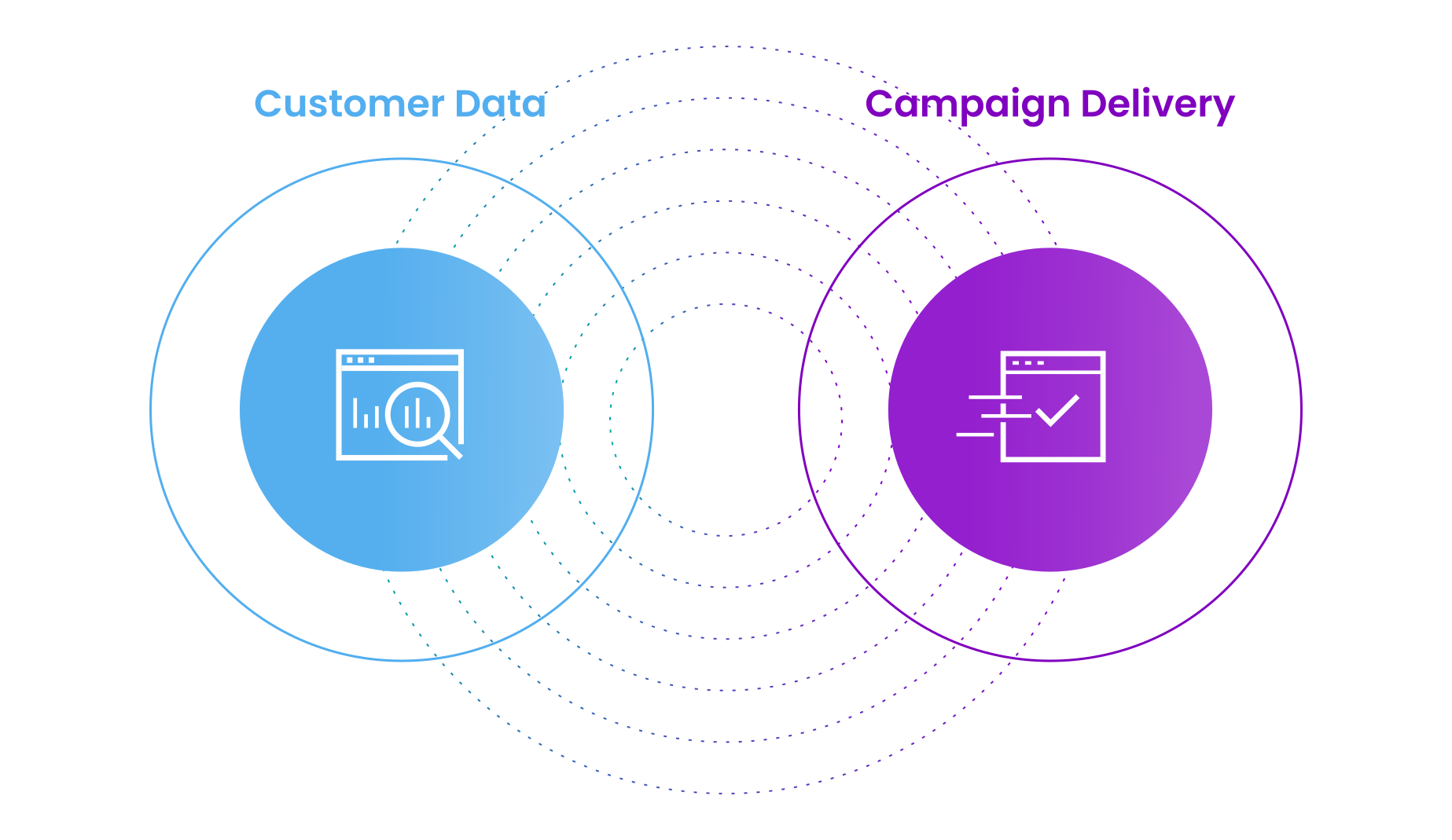
Close the gap between customer data and campaign delivery
Retailers do not necessarily need another large platform.
They may already have a capable CRM, ecommerce system, loyalty engine, ESP and marketing cloud. What is often missing is the layer between where customer data is stored and where campaigns are executed.
Apteco works alongside existing technology as a CRM marketing companion. It gives marketers a dedicated environment in which to explore customer behaviour, create segments, compare audiences and prepare them for activation. Instead of replacing the current stack, it helps retailers get more from it.
That changes the questions marketing teams can answer.
Rather than asking:
Who should receive this campaign?
They can ask:
Which customers are driving the change we can see?
Who is most likely to respond?
Which customers need an incentive and which would buy anyway?
Who should be excluded because another message is more relevant?
These are better audience decisions, not simply faster list selections.
Build audiences around real shopping behaviour
Retail customers rarely fit neatly into static demographic groups.
Two customers of the same age and location may behave completely differently. One may buy every week across several categories. The other may shop twice a year and only during promotions. A CRM marketing companion allows retailers to create audiences using the behaviours that actually influence value.
That might include:
- How recently someone purchased
- How frequently they shop
- How much they spend
- Which categories they favour
- Whether engagement is increasing or falling
- How they behave across online and store channels
- Their likelihood to respond, lapse or purchase next
This makes it possible to distinguish between customers who may otherwise look similar within the CRM.
A recent first-time buyer could enter a journey designed to encourage a second purchase. A regular shopper whose frequency is falling could receive a timely intervention. A customer with strong category affinity could be prioritised for a relevant launch rather than included in a broad promotional send. The result is marketing shaped by behaviour rather than database availability.
For a quick visual explanation of how this approach extends traditional CRM capability, see the infographic: Why marketers need a CRM marketing companion.
Move from reacting to predicting
Retail marketing often begins with what has already happened.
A customer bought a product. A category declined. A shopper stopped engaging. A basket was abandoned. These signals remain important, but they do not have to be the end point of the analysis.
Predictive models, customer scoring and lookalike techniques can help retailers identify what may happen next. Marketing teams can find customers who are likely to purchase from a particular category, become more valuable, respond to an offer or show early signs of lapsing. That creates a more proactive approach.
Instead of waiting until a high-value customer has disappeared, the retailer can identify a change in their normal pattern. Rather than promoting a category to everyone, the team can find customers who resemble its best existing buyers.
The webinar also highlighted how visual audience tools can help marketers compare groups and understand overlap before activation. This makes it easier to choose the most appropriate treatment when several campaigns compete for the same customer.
Retail speed still requires control
Audience agility should not become an excuse to send more communications.
The value comes from improving relevance. Retailers often have several teams competing for customer attention. Trading may want to support an underperforming category. Loyalty may have a member offer ready. Ecommerce may want to recover an abandoned basket. CRM may already have a planned journey running.
Without prioritisation, the same customer can qualify for all of them. A CRM marketing companion helps teams understand this overlap and apply the appropriate decisioning rules before activation.
That may involve:
- Selecting the most relevant communication
- Applying frequency and suppression rules
- Removing duplicate audiences
- Protecting control groups
- Excluding customers unlikely to benefit
- Prioritising one commercial objective over another
Faster decision-making only works when the underlying data can be trusted. The audience identified during analysis must match the audience available within the activation platform.
The webinar highlighted the operational problems created when those numbers do not reconcile. A team may select 100,000 customers, only to lose a substantial proportion when the audience reaches the delivery platform. Audience agility therefore depends on consistent data across reporting, analysis and activation, not just a faster interface.
Learn as quickly as you launch
The process should not end once the campaign goes live.
Retailers need to understand which customers responded, which segments underperformed and whether the campaign generated incremental value.
A CRM marketing companion can help build measurement into the campaign process through control groups, audience comparisons and post-campaign analysis. This creates a faster test-and-learn cycle.
A retailer can launch a campaign, review the response and feed that learning directly into the next audience decision. A segment that performed well can be expanded. A group that did not respond can be removed. A campaign that is no longer relevant can be stopped.
The webinar described this as the ability to build and run a campaign today, review it tomorrow and return to the audience tools to refine it. That turns audience agility into continuous improvement rather than one-off speed.
Start with one retail problem
Improving customer marketing does not have to begin with a large transformation programme.
A more practical starting point is to identify one part of the process where the retailer is losing time, relevance or commercial value.
That might be:
- Increasing second-purchase rates
- Reducing customer lapse
- Supporting an underperforming category
- Improving abandoned-basket conversion
- Increasing loyalty participation
- Coordinating online and in-store audiences
A focused pilot gives marketing teams the opportunity to work with a managed, privacy-safe dataset, test the approach and demonstrate value without disrupting the wider technology environment.
This reflects one of the webinar’s clearest recommendations: improve the part of the process that is causing the greatest problem, prove the incremental impact and build from there.
Turn retail signals into action while they still matter
Customer data creates value when it changes the next decision.
A CRM marketing companion helps retailers shorten the distance between identifying a change in customer behaviour and responding with an appropriate action.
It gives marketers greater access to insight, more control over audience creation and a clearer connection between analysis, activation and measurement.
The retailer keeps the systems it already relies on. Marketing gains the agility needed to use them more effectively.
Download the free eGuide, Convert your data into impact with a CRM marketing companion, to explore how a companion approach can help turn existing customer data into more relevant and measurable marketing action.
Related reading
This article is inspired by the recent Apteco and Plinc webinar, 'From insight to action: Building smarter campaigns faster'. You can read Plinc's summary of the discussion for an alternative perspective on the key themes covered.